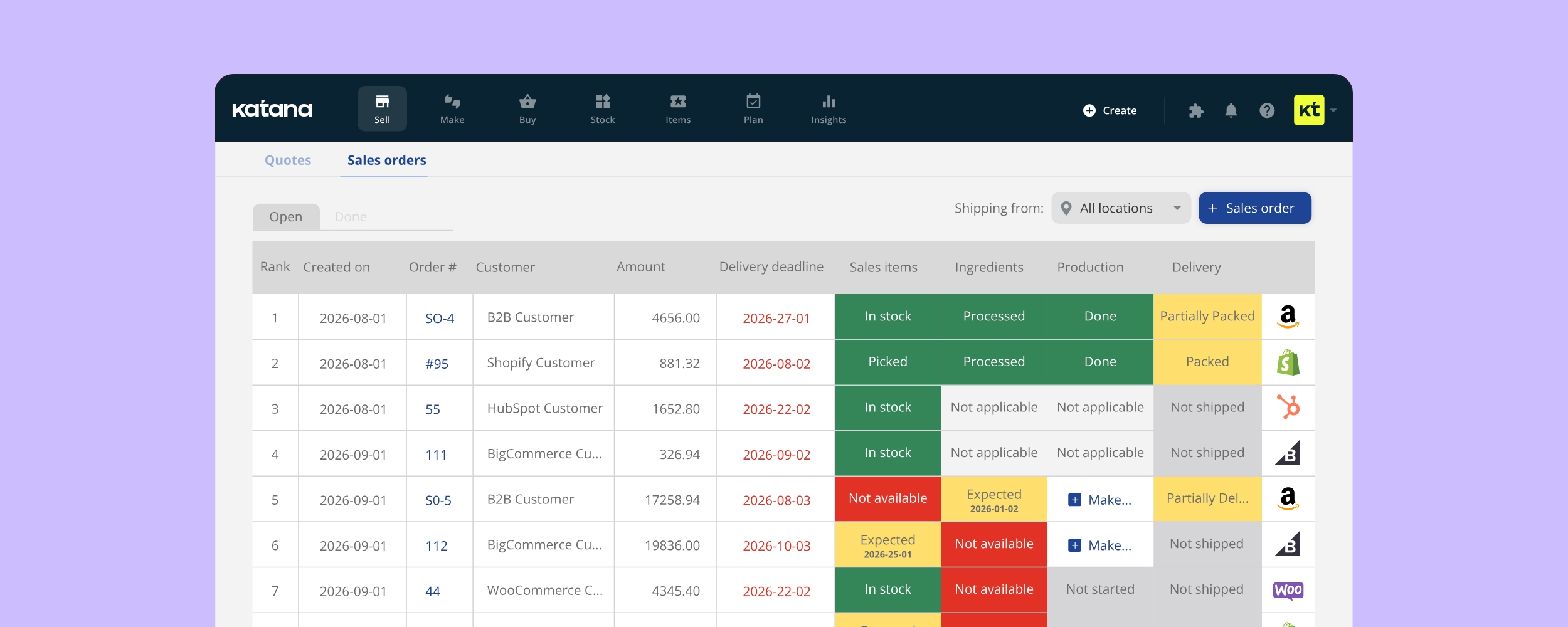
How we build composable ecommerce experiences with Katana.
Katana suits brands that make what they sell. Your available stock depends on what you can produce, not on what you have ordered in.
We connect production planning to your sales channels so the storefront shows what can actually be made and shipped. That stops you selling product you cannot deliver on time, and stops your team reconciling two systems by hand every week.
Brand partners
Forging paths, in good company.
Is Katana right for my ecommerce brand?
Who it's for
Brands that make what they sell, where stock is not simply bought and resold but assembled, produced or batched.
Manufacturers selling direct as well as wholesale
Brands with bills of materials and component stock
Businesses running production alongside ecommerce demand
What it solves
Available stock depends on production capacity, not a purchase order
Sales are taken for product that can't be manufactured in time
Materials and bill-of-materials data sit outside the commerce picture
Production planning and sales channels are reconciled by hand
Common questions about integrating Katana for your ecommerce brand.
What makes manufacturing inventory different from retail inventory?
You have to track components as well as finished goods, and know what you could make rather than only what you have. A retail system tells you there are twelve units left. A manufacturing one tells you there are twelve, plus parts for forty more.
Do we need Katana if we already use Shopify?
Only if you produce rather than resell. Shopify counts finished goods well and has no concept of what those goods are made from. If your stock problem is really a production planning problem, that gap is the one causing your stockouts.
Can Katana handle both DTC and wholesale demand?
Yes, and that is a common reason brands adopt it. Wholesale orders arrive in large, lumpy quantities while DTC trickles. Planning production against both at once is difficult by hand and reasonably straightforward with the right system.
How does Katana connect to our storefront?
Through integrations that pass orders in and stock levels out, so the website reflects what can actually be fulfilled. The detail that matters is how made to order products are represented, since showing them as out of stock loses sales you could have taken.
How long does a Katana setup take?
Four to eight weeks, and the length depends almost entirely on how well documented your bills of materials are. Brands with recipes in someone's head take longer than brands with them written down.
Brand partners
Forging paths, in good company.
CONTACT US
Let's build better commerce, together.
Give us a call at +1 (833) 866-5423 or leave us a note. We'll get back to you in no time.
Thank you! We'll be in contact with you shortly.
Looking forward to building better commerce.
Oops! Something went wrong while submitting the form.